Note to Readers:

Like any travel, journeying inward provides unexpected pleasures in about equal measure with painful discoveries. Writing has always been my way of expressing my inner self and securing a place for important experiences in my memory. This blog will include some antiques worth re-considering, some pieces written intially for only one reader and new reflections on my world as it continues to unfold.
Showing posts with label Haiti. Show all posts

Wednesday, May 4, 2011

Labadee, Haiti...#2 The Girl

Her face haunts me.

I met this girl at Paradise Cove in Haiti and though she tried to tell me her name three times, her Creole accent and soft voice made it unintelligible to my American ears. I call her Atabei, for the Taino creator, the original mother in the ancient culture of the Caribbean. It seems fitting as the power of her gaze fills me every time I look at the one good picture I got of her.

Atabei spoke enough English to tell me that she was seven and her brother was 14. She was simply hanging around on the beach where we visited, accompanying her father, who sold sea shells to the visiting tourists. I asked, but couldn't get a clear answer from him where the shells came from, but I gathered he bought them from someone else to sell. Most likely a merchant who paid divers in other areas for the shells. I think Atabei's father and his family decorated many of the shells with the word “Haiti” themselves.

Of course I bought one without the man-made décor. This family seemed to include another young adult (uncle perhaps) who sold metal art a few feet up the hill from the shell merchant.

Neither man knew enough English, it seemed, for conversation beyond the practiced phrases to sell their wares to the tourists, which I assumed they did with the encouragement of the American owner of the cove, since it was private property. Perhaps mom was one of the women up in the simulated village, demonstrating how to roast coffee or make peanut butter from scratch (don't forget to add a tiny dash of hot pepper at the end). I didn't ask.

There were lots of questions I didn't ask of these people, especially of Atabei, who fascinated me. I didn't even take as many photos as I'd have liked—feeling unusually shy about imposing on their lives. I did ask for her permission to take her picture, but I kept feeling like the things I wondered about might be rude to ask. It was a weekday; didn't she go to school? Did she and her brother take off to help her father whenever there were ships in port (maybe one or two days a week) to help make the scene more picturesque, and sell more shells and metal? Was school simply unaffordable for them? Where was her mom? What did she want to be when she grew up? Did she even think of such choices? What did she like to do? If I'd known Creole or she'd known more English, if I'd have been braver about intruding, I'd have asked lots of questions.

Her face seemed so solumn in repose. I don't think I saw but a hint of a smile once, and then it was gone. Her brother too, didn't smile, though the father did a bit, as he encouraged me to buy something and gathered eveyone for a group picture. But they didn't smile in the pictures, I noticed later when I looked more closely. Bad teeth? Unfamiliar custom? Nerves?


There was a quiet stillness about this child that I found unnerving. She seemed able to remain quiet and unmoving, relaxed yet alert, in a way that belied her young age. The contrast to what an American 7 year old would be doing was astounding. Is sitting around and doing basically nothing the norm for her in her world?

There's so much I didn't know, and didn't ask. Where was their house...back in the village of Labadee? What was it made of, how many rooms? What was Atabei's favorite food?

I think her face has stuck with me for many reasons, but the primary one is the huge gap between our cultures which had me tongue-tied with a child—a totally new experience.

I'm usually the one who can talk to children, from toddlers to teens, from any background, who can always find the right question to ask to get them talking about themselves and their world.

Here, in this poverty and sun drenched cove, I didn't know where to begin.


Wednesday, April 27, 2011

Labadee, Haiti...#1


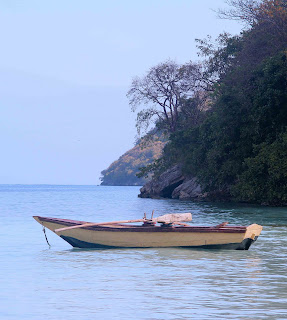
There are hardly any roads in Labadee, Haiti. The once tiny village of 600 is now grown to about 6000 due to the Royal Caribbean Cruise lines development of the penninsula as a private resort destination for their ships. (The newly constructed dock helped ferry supplies into the country in the immediate aftermath of the recent earthquake. Now it hosts luxurious vessels.) Labadee sits nestled by the edge of the sea separated by tall volcanic peaks from Cap Haitien to the south. Along this northern coast, most stay where they are or travel by boats, usually well-worn dinghies patched and rowed by net wielding fishermen. We were lucky enough to escape the RCI penninsula for the morning on the Haitian Cultural Tour excursion.

We boarded a water taxi with about 30 others. The owner of the tour, an American ex-pat, and two Haitian young men took us to Paradise Cove.


Roberto summarized Haiti's long and difficult history while we remarked on the beautiful, mostly untouched coastline and the huge mountains which rose so steeply from the water's edge.


Paradise Cove, when we arrived, was one of the most unspoiled beaches I'd ever seen, and we waded ashore through soft white sand and protected, gentle tropical waters. The palm-spotted beach was backed by steep mountains with only one house and a boathouse nearby, built into the hillside. Once ashore, the group was divided into two smaller groups each taking turns on the climb up the zig zagging hillside path to the village, while the remainder enjoyed relaxing on the beach, or on lounges floating in the calm turquoise water.


I've read some online critiques of this “village” tour because the village was created specifically for the purpose of educating and entertaining tourists.

My own response was, “So are Plimoth Plantation and Sturbridge village” in my home state of Massachusetts. Locals employed to re-inact what life was like in the sixteen and eighteen hundreds. I see no real difference. The Haitians employed by this tour are locals hired to demonstrate how things are done in the villages inland—which we'd never have any chance to see, otherwise. It's not perfect, but it helped me begin to understand a bit.


And it pumps money into the local economy. Those who were hired as guides had excellent English while the “villagers” had much less, but the craftsmen had the opportunity to sell work and the musicians and guides got additional tips. The tour owner is the second largest employer in the area with about 25 locals at work here.


I came away from this tour with some new perspective. In particular I was fascinated by how many activities in the village require an extended charcoal fire...it's so easy for us to criticize from afar those who cut and burn the rainforest for the trees. If you are stuck without the ability to buy charcoal or wood, you make your own from whatever you can find. The Haitian villagers, we were led to believe, are basically “living off the land” around them. It may not be “sustainable” but it sustains the family then and there. It's very arrogant to make moral judgments on those who have so little, especially without offering an alternative.


The owner also commented at the changes he'd observed over the last three decades in Haiti and in the Dominican Republic. He said that the decision in the 80's by the Dominican government to invest in infrastructure—roads, airports, etc.--had made all the difference. Infrastructure brought investment and construction all along the coastline and now there is a thriving tourist industry with resorts, condos, cruises, and the businesses that supply them. In his words, he's even noticed the existence of an emerging middle class in DR who can now consume goods and keep the economy going. In Haiti, by contrast, any attempt to develop has only landed money into corrupt government pockets over the last 30+ years, discouraging potential building. How sad. Clearly the country has equally spectacular scenery and shoreline, ripe for some thoughtful development, if only there was a stable and honest government to deal with.


Overall, Paradise Cove was a little piece of heaven and a place I'd go back to in a flash.


Beautiful, restful, and educational. I'm sure it's only an approximation of the reality of the interior of Haiti—kind of like Plato's cave shadows. But it's far more than those who stayed on the RCI Labadee private peninsula got to see. They could have been on any well kept beach in the Caribbean; no reminders anywhere that they were actually in Haiti.